Free Motivational Coloring Pages — Print, Color, Believe
There's a reason a child who spends fifteen minutes coloring the word "BRAVE" remembers it differently than one who passes it on a poster — and the science behind it is genuinely surprising. When kids color a motivational quote, they process it three separate ways: reading the words, making color decisions around them, and feeling the physical act of filling them in. That triple encoding is why these pages work. Below you'll find ten free printable motivational coloring pages labeled by age range and complexity, so you can pick the right one in under a minute and have it printing before bedtime.
Motivational Coloring Pages
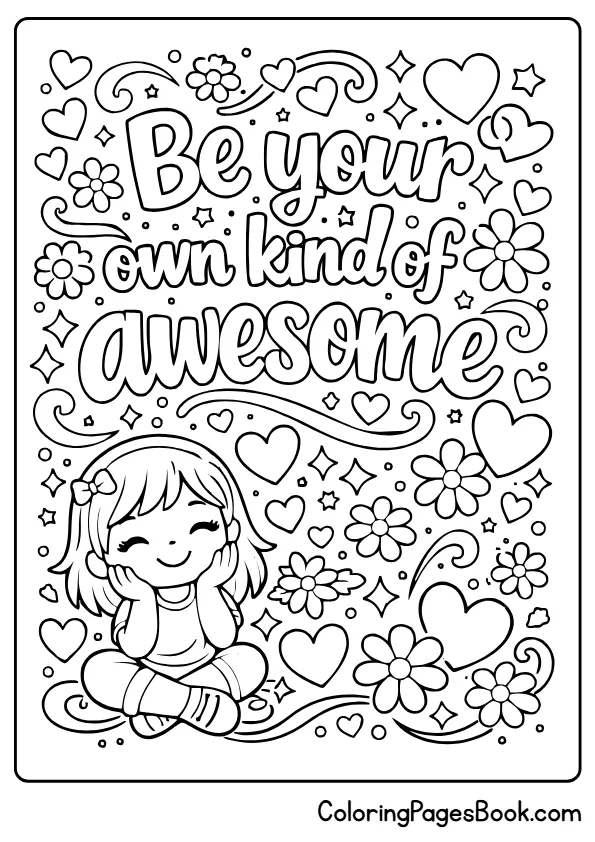
Bold lettering fills most of the page here, surrounded by stars and bursts that give younger colorists plenty of enclosed shapes to fill without getting lost in tiny details. Ask your child what “their kind of awesome” actually looks like — you’ll get an answer worth writing down.
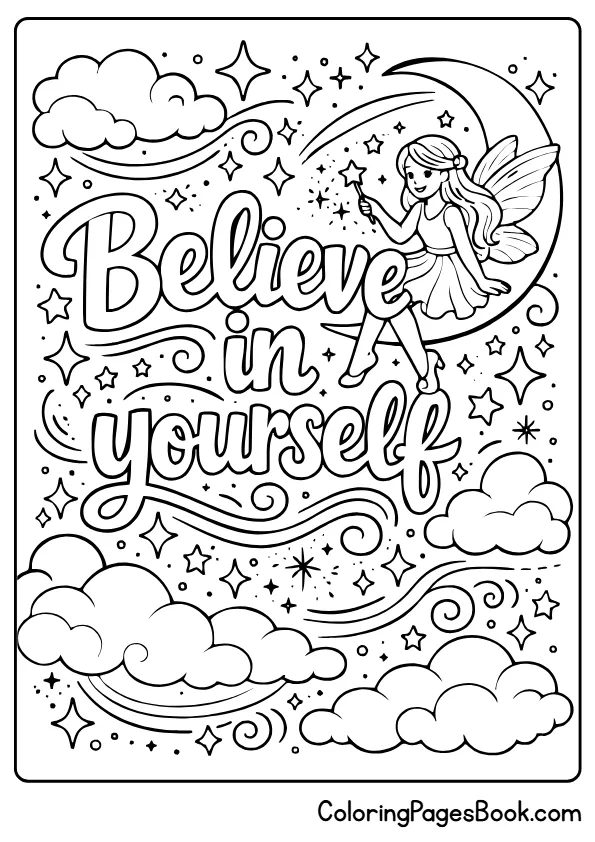
The phrase curves upward through the design, which gives it a feeling of momentum even before a single crayon touches it. Coloring from bottom to top — following the arc — is a small physical choice that mirrors the meaning, and kids notice that without being told.
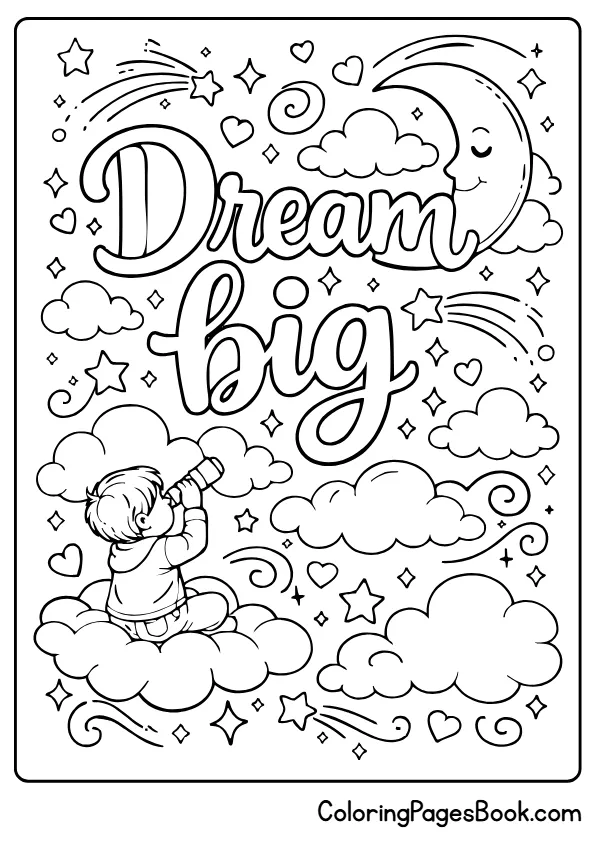
Stars of varying sizes frame this quote, giving a child real decisions to make: which star gets gold, which gets purple, which stays white. Color psychology research backs up what most parents already feel — warm yellows and oranges under “Dream Big” create a genuinely different emotional experience than the same page colored in grays.
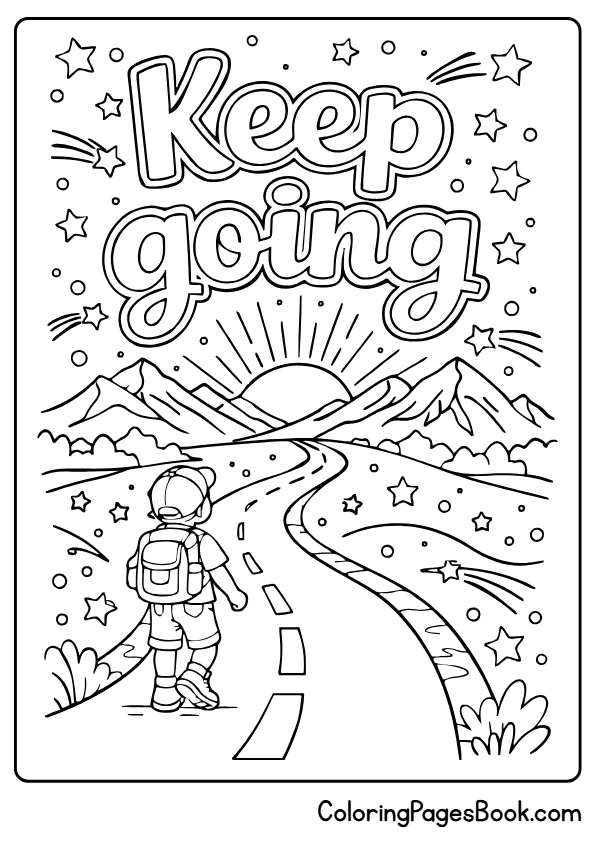
Short. Punchy. Two words that land hardest on a hard day. The spare design means this one works for ages 5 and up — there’s enough space to color freely without frustration, and the message doesn’t require any explanation before handing it over.
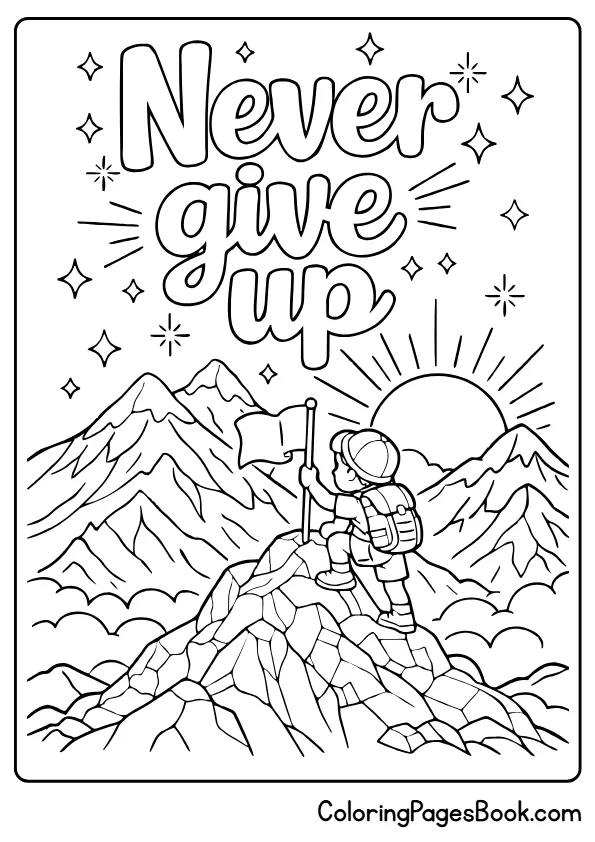
Decorative borders with repeating geometric shapes frame this one, making it more rewarding for kids in grades 3 and up who want something that takes real time to finish. The complexity is part of the point — completing an intricate page is its own small proof that they can keep going.
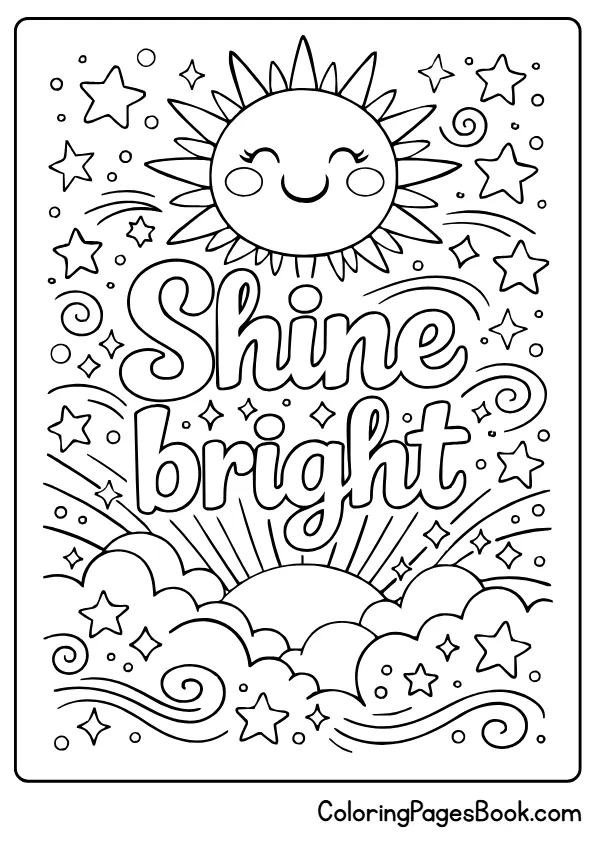
Rays extend outward from the lettering the way a child might actually draw the sun, which makes this one unusually easy to connect to. Your child can color the rays in a gradient — lightest near the center, deepest at the tips — to see how color creates the illusion of actual light.
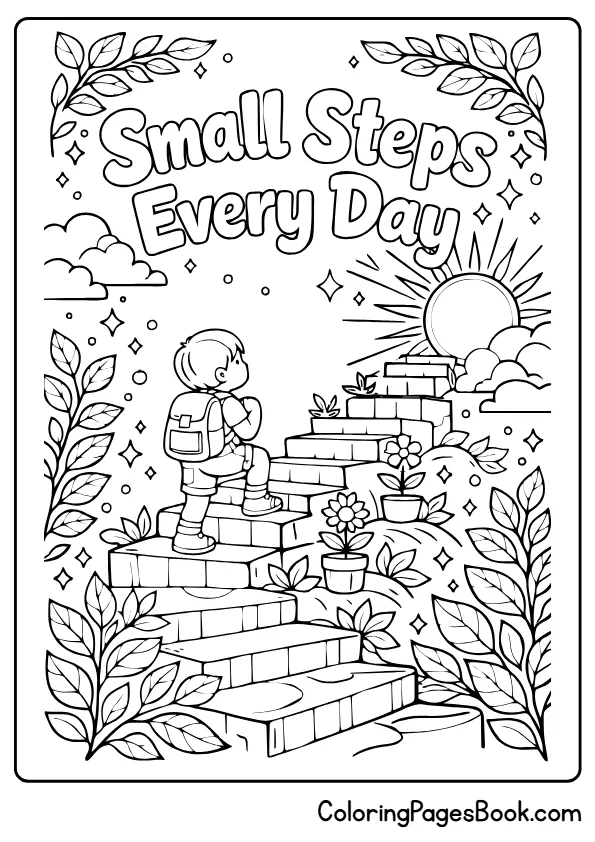
Four words that sit better with perfectionists and anxious kids than any “you can do anything” message, because this one is true in a way they can verify. After coloring, try asking what one small step they’ll take tomorrow — the answer is usually more specific than you’d expect.
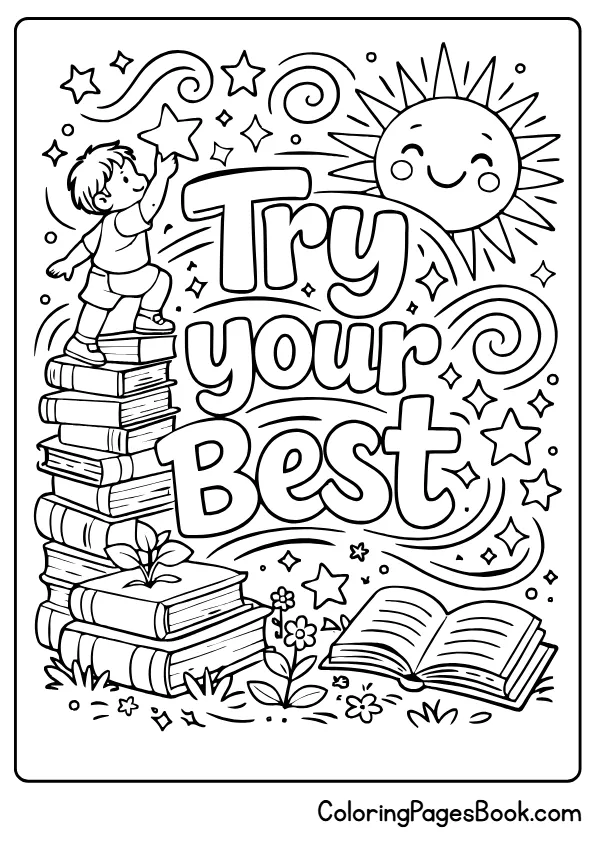
Clean, readable lettering with a simple illustrated border makes this the easiest page on this list for ages 4–6 to complete without adult help. That independence matters — finishing the page on their own is the first proof that the quote is already working.
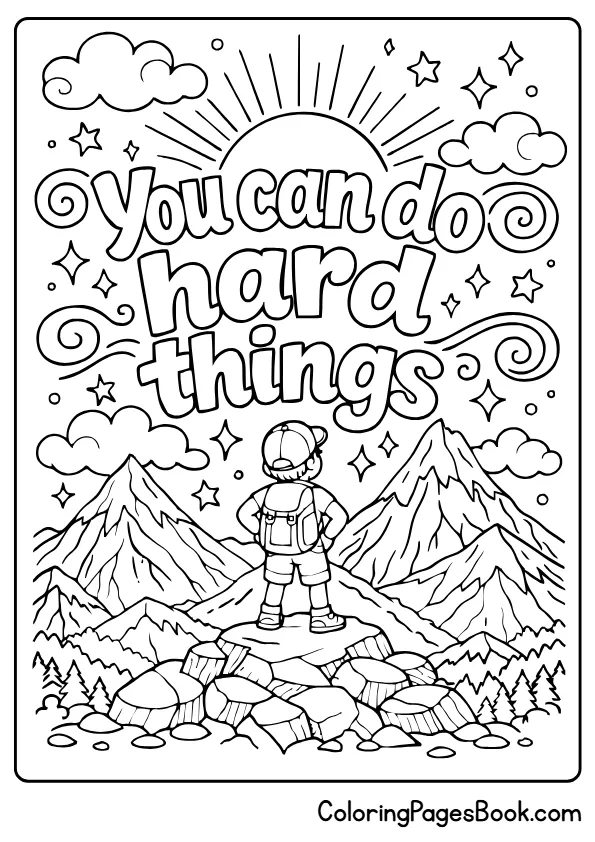
This phrase comes directly from the growth mindset vocabulary many elementary teachers already use in class, which means a child who brings it home from school has heard it before — coloring it cements the message in a way a classroom poster can’t. Moderate detail level suits grades 1–4.
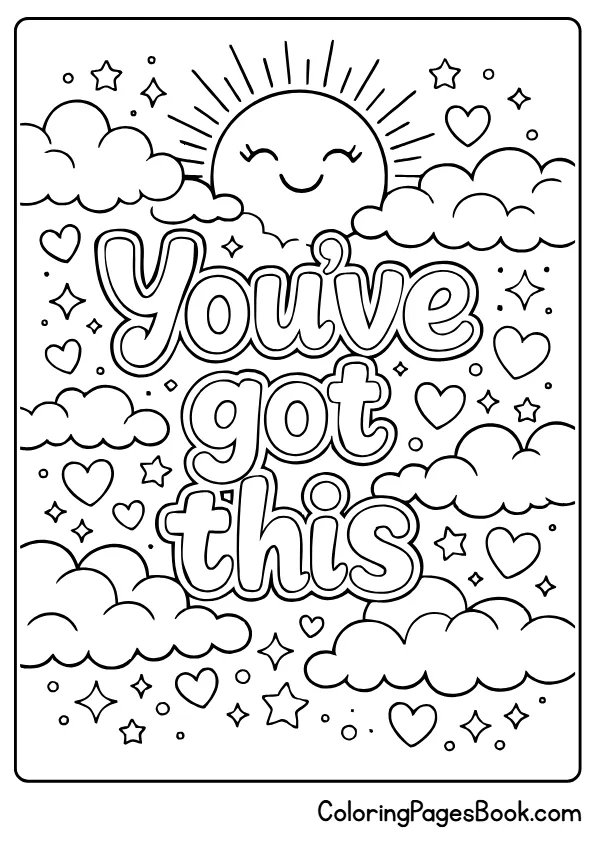
Encouraging without being saccharine. The layout gives this one a slightly bolder, more urgent feel than the softer quotes on this list — it’s the one to reach for before a test, a recital, or a dentist appointment. Print it the night before, not the morning of, so there’s time to actually color it.
Related Coloring Pages
Popular Coloring Pages


What Are Motivational Coloring Pages?
Motivational coloring pages are free printable pages that pair an uplifting quote — like ‘Dream Big’ or ‘You’ve Got This’ — with an illustration to color. They’re used by parents, teachers, and adults for stress relief, classroom calm-down activities, and test-prep routines. Most are designed for children ages 4–12, with complexity ranging from single bold words to full illustrated borders.
What Motivational Coloring Pages Actually Teach (Beyond the Quote)
Coloring motivational quotes builds a specific kind of pencil control that generic coloring pages don’t. When a child fills in block letters, they have to navigate concave curves, thin strokes, and enclosed spaces — exactly the fine motor challenges that prepare a kindergartner or first grader for handwriting. It’s a legitimate pre-writing exercise that looks like free time.
Vocabulary sticks differently when a child spends twenty minutes physically surrounded by a word. A six-year-old who colors “persevere” for half an hour has a felt relationship with that word — you can point to the finished page on the fridge and ask “What did persevere mean again?” and they’ll remember, because the memory has a visual and physical anchor. Teachers can use completed pages exactly this way as vocabulary call-backs weeks later.
These pages also quietly practice self-regulation — and that’s the developmental benefit most parents don’t expect. Choosing which colors to use, staying within lines at the child’s current level, and finishing a full page each require inhibitory control, sustained attention, and basic planning. School counselors and occupational therapists recommend structured coloring (not free drawing, but structured coloring) for children who struggle with emotional regulation, because the bounded task gives the nervous system something predictable to hold onto.
For kids with academic anxiety specifically, the research is clear. A 2006 study by Cohen et al. found that regular self-affirmation exercises reduced stress and improved academic outcomes in adolescents — and the effect was strongest for students already under pressure. Pairing the affirmation with the calming structure of coloring adds a second layer. It’s not busywork. It’s a two-for-one.
5 Ways to Use These Motivational Coloring Pages That Go Beyond Coloring
Quote of the Week Wall
Each Monday, choose one page together and talk about what the quote means before anyone picks up a crayon. After it's colored, hang it somewhere the child will actually see it — not a portfolio drawer. By Friday, ask them for one moment that week where the quote turned out to be true.
Pre-Test Ritual
The night before a test, let your child choose whichever page they want and color it with no time pressure. Research on amygdala calming shows even five minutes of structured coloring shifts the nervous system away from threat-mode — doing it the evening before means they go to bed having done something that felt good and said something true about them.
Vocabulary Color Code
Pick a quote with a word your child doesn't know yet — "persevere," "resilient," "achieve" — and challenge them to color that specific word in a completely different palette from the rest of the page. Then define it together before they start. The physical distinction makes the word visually memorable on the finished page.
Mood-Matching Palette
Talk through the color-mood connection before starting: warm yellows and oranges go with quotes about energy and possibility; cooler blues and greens suit pages about patience and calm. Let your child decide what feeling they want to build into the page, then choose colors from there. It turns a coloring session into a brief, real conversation about emotional self-awareness.
Family Coloring Swap
Print the same page twice — one for the child, one for a parent. Color them separately, then compare. The different color choices are usually striking and always interesting: why did you pick blue for "brave" and I picked red? That conversation is the point.
Frequently Asked Questions (FAQs)
What age are motivational coloring pages good for?
Most motivational coloring pages work well for children ages 4–12, but the right page depends on complexity more than age. For ages 4–6, look for bold single words (“BRAVE,” “KIND”) with simple outlines and large spaces to fill. Ages 7–9 can handle short phrases with moderate illustration detail. By grades 4–6, kids are ready for full quotes with intricate mandala-adjacent borders that take real time and attention to complete. The pages on this list are labeled by approximate age range so you don’t have to guess.
Can coloring pages really reduce test anxiety in children?
Yes — and the mechanism is specific. Coloring quiets the amygdala, the brain’s threat-detection center, by occupying just enough focused attention to redirect neural resources away from anxious scanning, without requiring the kind of cognitive effort that creates new stress. It’s sometimes called the “Goldilocks zone” of calm focus. Teachers have developed a concrete version of this: placing a motivational coloring page on desks during the five to ten minutes before state testing begins, using it as a structured bridge between the anxiety of arrival and the focus testing requires.
Do motivational coloring pages actually help with anxiety in adults?
They do, and the research is more substantial than most people expect. Coloring — particularly mandala-style coloring — has been shown to reduce anxiety more effectively than free drawing or reading in controlled studies, likely because the symmetrical structure gives the brain a predictable visual anchor. Carl Jung, who studied color and the unconscious mind for decades, described color as “the mother tongue of the subconscious” — and used art exercises with patients long before adult coloring books existed. For adults who find meditation difficult, structured coloring produces similar brainwave patterns with a much lower barrier to entry.
What colors should I use on a motivational coloring page?
Warm colors — yellows, oranges, coral — suit quotes about energy and possibility; cooler blues and greens work better for patience and calm. Let the mood you want to build guide the palette more than aesthetics alone.
How do teachers use motivational coloring pages during testing season?
The most effective classroom use is as a pre-test warm-up ritual — five to ten minutes of quiet, structured coloring before a high-stakes test begins. It re-establishes routine on a morning when everything else feels off, calms the nervous system without requiring stillness (which anxious kids often can’t sustain), and puts a positive affirmation in front of each student right before they need it. Teachers also use these pages for morning meeting, indoor recess, and post-test debrief days when students need to decompress. Grade-level guidance: simple bold-word pages for PreK–K, short-phrase pages for grades 1–3, and quote pages with detailed borders for grades 4–6.
The color choices your child makes on these pages matter more than they look like they do — and the conversation that happens while they’re deciding between orange and gold for “Dream Big” is often the best part. Print the one that fits today, not the most elaborate one. The right page is the one that actually gets colored.